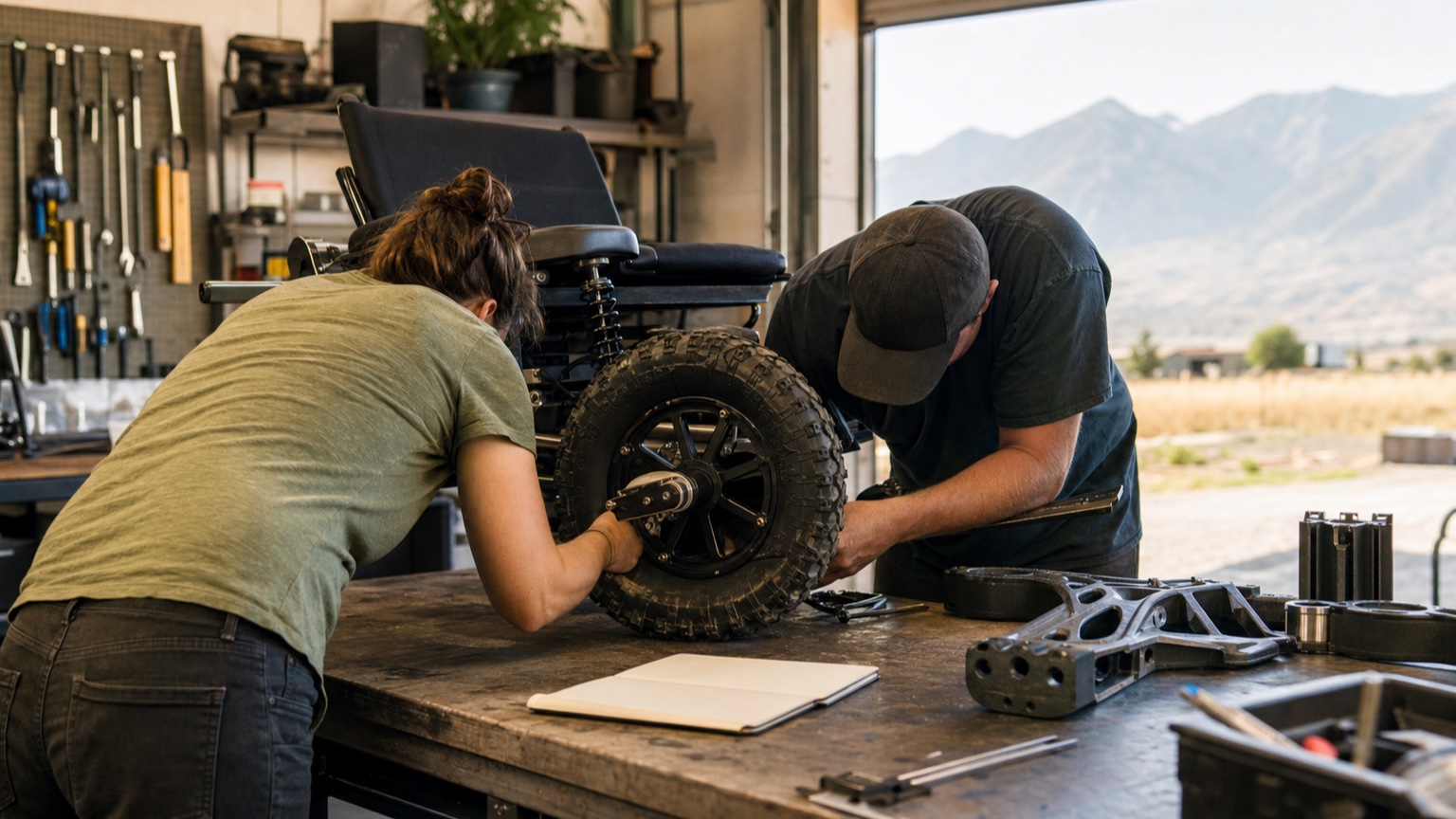
A $100 reservation is doing more than holding a place in a production line at a Spanish Fork workshop. It is turning interest into a signal that the operators can count.
Not A Wheelchair is currently accepting refundable deposits for the Rig 2.0, an off-road adaptive mobility product developed by Zack and Cambry Nelson. When its official product page was reviewed Tuesday, the company displayed its July and August shipping rows as filled and listed 19 openings in a September row.
That display is a useful signal, but it needs a boundary around it. It is controlled by the company, can change quickly and does not establish completed sales, revenue or profit. The $100 payment is described as a fully refundable deposit; final pricing depends on configuration. It is evidence of an active reservation process—not audited proof of market size.
The more durable story is how the Spanish Fork operation reached this stage.
Utah Business reported July 14 that Zack initially assembled an off-road chair for Cambry by welding a seat between two electric bicycles. He filmed the work for his JerryRigEverything channel, where viewers responded to the engineering and asked why a lower-priced version was not broadly available.
Not A Wheelchair launched in 2020, according to the magazine. The company now develops both manual wheelchairs and off-road products from Spanish Fork.
The operating lesson is not that every Main Street business needs a large video channel. It is that an audience can become a research surface when an operator shows the work early enough for people to react before the expensive decisions become permanent.
JerryRigEverything already had substantial reach. Its official YouTube channel displayed 10 million subscribers when reviewed for this issue. Most local operators will never have that scale, and copying the Nelsons’ distribution advantage would be unrealistic.
The underlying loop, however, scales down cleanly.
A prototype becomes visible. Customers identify the part they understand, the part they distrust and the job they still cannot complete. The operator sorts those reactions, changes the product and returns with another version. A reservation then asks whether enthusiasm survives contact with a real decision.
Not A Wheelchair’s current product page makes that decision unusually legible. It names multiple configurations, publishes specifications and launch prices, explains that final pricing may vary and offers a refundable place in line. That structure separates casual attention from a customer willing to provide contact information and a deposit.
It also introduces obligations. A reservation is not free market research. Once money changes hands—even refundable money—the operator must communicate clearly about timing, configuration, refunds and changes. A visible production calendar raises expectations as quickly as it clarifies demand.
Operators considering the same approach should resist the temptation to count comments as orders. Comments reveal language, objections and use cases. Reservations reveal stronger intent. Completed purchases and repeat use answer different questions again.
The distinction matters in physical businesses, where inventory, labor and supplier commitments can turn an optimistic forecast into a costly room full of unfinished goods.
There is another caution. Public participation does not replace professional testing, accessibility expertise or direct consultation with the people who will use a product. A popular suggestion may be technically unsafe, operationally impractical or relevant only to the loudest part of an audience. The company’s public process demonstrates a feedback mechanism; it does not independently prove every design decision or performance claim.
Still, the mechanism is available to a bakery, repair shop or home-service company without a studio or millions of followers.
Take 30 minutes today and collect the last 20 meaningful customer comments, calls or service questions your business received. Put each into one of four columns: job the customer was trying to complete, friction they encountered, workaround they used and evidence they would pay for a better option.
Choose one repeated friction—not the most dramatic complaint—and design a reversible test around it. A restaurant might offer one pickup window before changing its whole service line. A contractor might show two material packages before stocking either. A retailer might take refundable reservations before ordering a new category.
Set the decision rule before the test begins: the number of qualified responses, deposits or completed purchases required to continue. Also name the condition that will stop the experiment.
That is the transferable Spanish Fork signal. Not A Wheelchair did not keep every prototype behind a closed door until it looked inevitable. Its operators exposed the work, listened for repeated needs and gave interested customers a concrete next step.
The audience did not eliminate risk. It helped make the next risk smaller, visible and measurable.