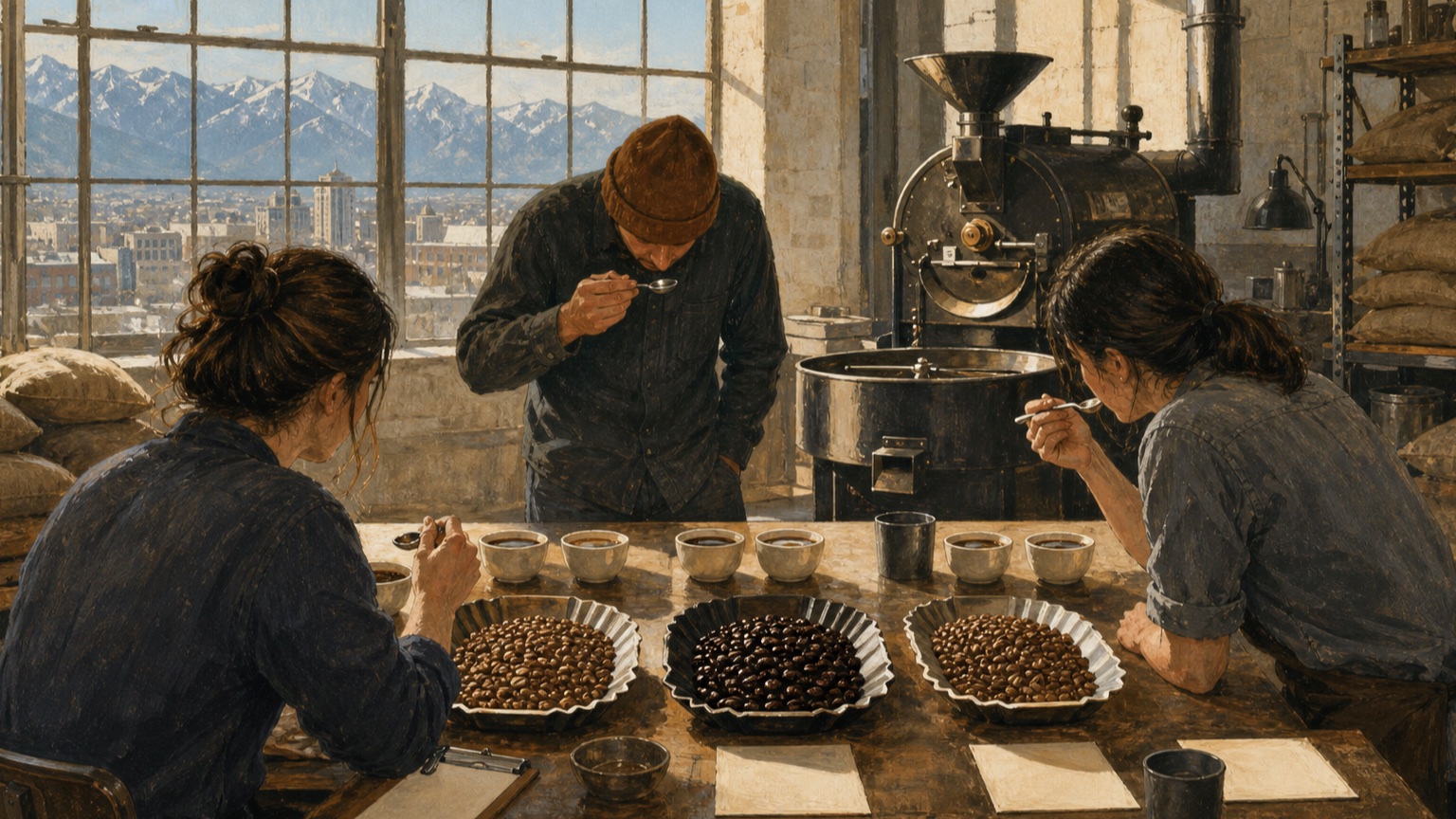
Publik Coffee Roasters has spent more than a decade teaching Salt Lake City customers what to expect from its cups. Now it is asking them to make room for something darker.
The company’s current menu includes 9Line After Dark, which Publik identifies as its debut dark roast. Its product page describes a blend of washed coffee from Peru and naturally processed coffee from Ethiopia, with listed tasting notes of cherry, semi-sweet chocolate and pecans.
That is a product announcement. The more useful Main Street signal is the way an established operator can move beyond a familiar lane without pretending its history never happened.
Publik’s own promotion places a clear boundary around the change: this is the first dark roast from a shop that has spent more than a decade refining light and medium profiles. Rather than quietly placing an unfamiliar bag on the shelf, the company explains what changed and connects the new product to the standards customers already know.
The business is not presenting darkness as a rejection of specialty coffee. Its product copy emphasizes balance, sweetness and complexity, while also making the practical case that the blend can be taken black, with cream and sugar, as espresso or through another brewing method.
That framing matters.
When a business has a recognizable point of view, expansion can look like surrender. A neighborhood restaurant that adds a simpler entrée may worry about diluting its kitchen. A contractor introducing a lower-cost package may fear that customers will question the premium work. A retailer testing a more conventional product can appear to be chasing volume.
Publik’s release demonstrates another option: name the departure, preserve the operating principles and explain which customer job the new offer is meant to complete.
The timing comes with a credible base behind it. In a profile published July 20, Utah Stories reported that Missy Greis founded Publik in 2014. The publication said the company now operates four distinct locations and employs 67 people.
Publik’s official site independently lists four Salt Lake City locations: Avenues, Publik Ed’s, Publik Kitchen and Downtown. It describes the company as a small-batch roaster that roasts to order.
**Uncertainty note:** The employment figure comes from the Utah Stories profile and was not independently confirmed through a public company filing. Neither the profile nor Publik’s product page provides audited sales, margin, inventory or customer-retention data for the new roast. The release proves that the product is publicly available; it does not yet prove commercial success.
That distinction keeps the operator lesson grounded.
An established business does not need to bet the brand every time it widens the menu. It can create a bounded test: one product, one named customer need, one visible connection to the existing promise and one review date.
Publik’s existing architecture makes that test especially legible. The dark roast sits beside several other current coffee offerings rather than replacing the assortment. The company publishes its origin, process, roast level and tasting notes. Customers can compare it with the rest of the line before buying.
That reduces interpretive friction. The customer does not have to wonder whether Publik has changed direction completely. The company has introduced a new choice within a recognizable system.
There is also a lesson in how the product is named and situated. “9Line After Dark” links the release to Salt Lake City rather than treating it as an anonymous commodity. The local reference does not prove quality, but it gives the experiment a place inside the brand’s existing community story.
Operators should be careful here. A clever name cannot compensate for poor economics or inconsistent delivery. Nor should a company describe every ordinary line extension as a historic reinvention. The useful move is proportionality: make the change visible enough to measure, but not so grand that the marketing outruns the evidence.
Take 30 minutes today and draw a three-column product-boundary sheet.
In the first column, write the promise customers already associate with your business. In the second, name one request you repeatedly hear but do not currently serve. In the third, specify the non-negotiable standard that any new offer must preserve.
Then design the smallest test that crosses the boundary without erasing it.
A bakery might produce one weekly batch in a requested flavor. A repair shop might pilot a fixed-price inspection before rewriting its entire service menu. A retailer might stock one shelf rather than one room. Set a decision rule before launch: the number of completed purchases, repeat orders or qualified inquiries required to continue.
Also set a stop rule. Attention alone is not enough. If the test adds training, waste or service complexity without producing durable demand, retire it cleanly.
Publik’s new roast may become a permanent favorite, a useful niche or a short-lived experiment. Public evidence does not yet answer that question.
What it does show is an operator making a controlled move outside an established lane—and giving customers enough context to understand that the business has expanded its range without abandoning its center.