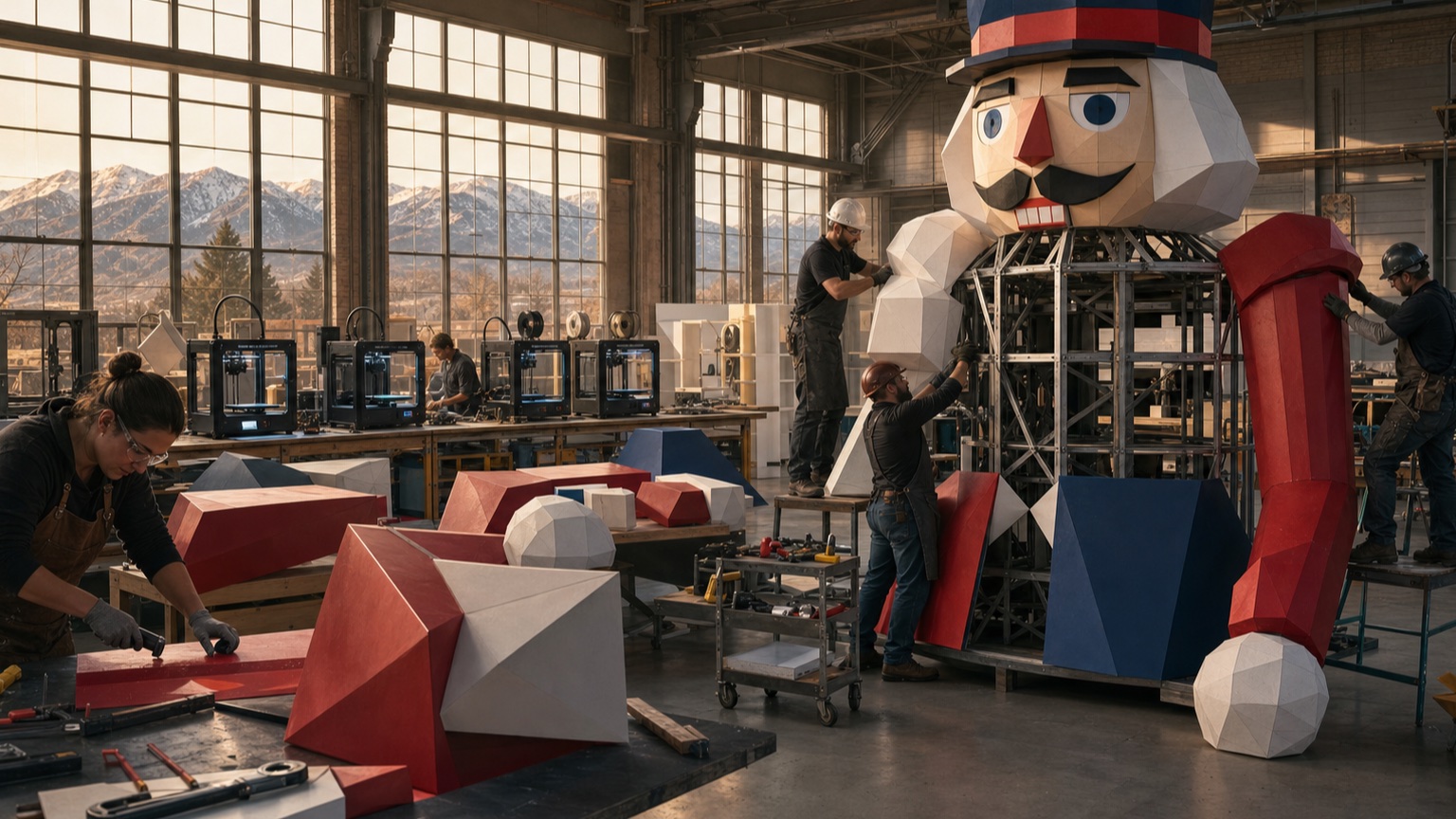
The giant left Ogden in 21 pieces.
WhiteClouds, a custom fabrication company founded by Jerry Ropelato, did not attempt to move its nearly 66-foot nutcracker to Minnesota as one heroic, highway-blocking object. The company divided the structure among six staged shipments, sending the lower sections first so crews in Luverne could assemble it in sequence.
That logistical choice is the most useful part of an otherwise spectacular story.
The finished figure, called Verne the Patriot, stands 65 feet, 7½ inches tall, according to an Associated Press report from its July unveiling. KSL reported that it weighs more than 9,000 pounds before counting the base and support tower built separately in Minnesota.
The sculpture has a working jaw. Its body includes nearly 5,000 pounds of foam, more than 3,000 pounds of metal, 752 pounds of coating and 255 pounds of paint, according to figures WhiteClouds supplied to KSL.
Luverne has submitted Verne for consideration by Guinness World Records. That recognition is **not yet confirmed**. The organization’s published record cited by both reports remains a 33-foot decorative nutcracker in Germany.
The verified Utah business signal does not depend on the record.
WhiteClouds took a commission with unusual structural, fabrication, weather and transportation constraints and converted it into a sequence that could be manufactured in Ogden, moved across several states and assembled at the destination.
Ropelato told KSL that the company operates a farm of about 100 3D printers. He said the machines are similar to hardware available to home hobbyists rather than exclusively high-end industrial printers. WhiteClouds combines that distributed printing capacity with foam fabrication, coatings, paint and an internal metal structure.
The company’s own site describes a much broader catalog: statues, trade-show displays, architectural models, product replicas, topographical maps, props and other custom work. That matters because Verne is not merely a novelty. It is a public demonstration of a repeatable capability: turning an unusual request into a buildable system.
The operating lesson begins with decomposition.
Large projects often become intimidating because the operator keeps treating the final object as the unit of work. A restaurant sees “open the second location.” A contractor sees “finish the basement.” A retailer sees “replace the inventory system.” Each phrase describes an outcome, but none gives the team a piece it can safely move today.
WhiteClouds had to make the interfaces visible. Twenty-one sections meant 21 physical pieces whose dimensions, attachment points and delivery order had to agree. Six shipments meant the arrival sequence mattered. Weather meant the materials could behave differently between Utah and Minnesota. On-site assembly meant work completed in Ogden still had to fit conditions hundreds of miles away.
KSL reported that WhiteClouds used artificial intelligence as a brainstorming tool while considering how many final sections the sculpture should have. Public reporting does not establish which system was used, how much time it saved or whether its recommendations were adopted without modification. The consequential decision remained a human engineering and logistics judgment.
That distinction is worth preserving. A planning tool can propose 18, 21 or 24 modules. It cannot assume responsibility for a crane lift, a structural connection or a delayed truck.
The AP report supplies an early commercial signal at the destination. Katie Walgrave, whose family operates the nearby rock shop Those Blasted Things, said customer traffic had quadrupled since the sculpture was completed in mid-June. That is a named operator’s report, not independently audited sales data. Other businesses were also said to be seeing more traffic, but no revenue figures were published.
For WhiteClouds, the stronger receipt is the completed handoff: fabrication in Ogden, staged transportation and assembly in Minnesota.
A Main Street operator can borrow the method without constructing anything taller than a storefront.
Take one project that has remained stuck for at least two weeks. Write the finished outcome at the top of a page. Beneath it, divide the work into modules small enough that each one has a single owner, an observable completion test and a known handoff.
Then apply this decision rule: **a module is not ready until the next person can receive it without guessing what “done” means.**
For each handoff, record four things: what moves, who receives it, what must already be true and how acceptance will be verified. Put the modules in delivery order. Identify the one interface most likely to fail.
Do not spend today refining the entire plan. Test that interface.
A caterer can confirm whether the venue’s loading window matches the food-preparation schedule. A remodeler can compare the cabinet dimensions with the finished opening before installation day. A retailer can export ten products into a replacement system before attempting the full catalog.
The impressive object in Minnesota is almost 66 feet tall. The durable advantage in Ogden was smaller: WhiteClouds made an impossible-looking commission movable, testable and sequential.
When the whole project cannot travel, divide it until the next piece can.