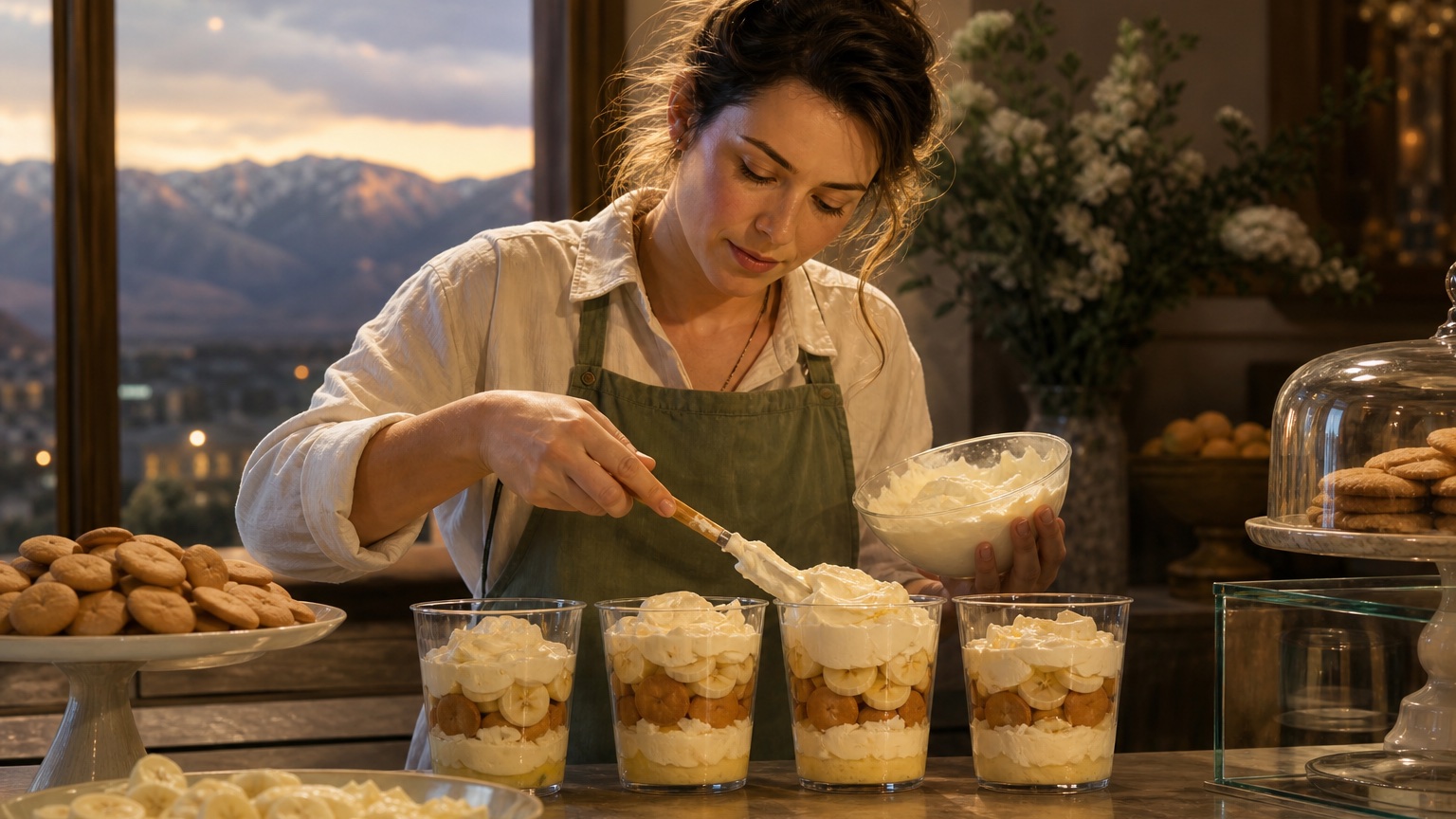
A small Sugar House shop has built its name around a dessert many restaurants leave near the bottom of the menu.
Parfé Diem does not treat banana pudding as an afterthought. The business makes it the center of the room.
ABC4 Utah identified Parker Barbee as the pastry chef and co-founder behind the concept. In a segment published July 24, Barbee said the shop makes its own vanilla wafers and aims for a whipped, light texture rather than the heavier consistency customers may associate with traditional pudding.
That distinction is more than a recipe note. It is the business model.
Parfé Diem’s website lists a storefront at 2040 S. 1000 E. in Salt Lake City, open from 11 a.m. until 11 p.m. daily. Its menu extends beyond the original banana version into flavors such as strawberry cheesecake and brigadeiro, but the format remains recognizable: a layered pudding parfait with a deliberate texture and presentation.
The shop also offers catering and packaged assortments, giving the same core product more than one occasion to serve.
The fresh signal is the attention gathering around that narrow proposition. ABC4 presented Parfé Diem as a local favorite, while Yelp independently included the business in its 2025 list of 100 notable local businesses across the United States.
Yelp says that list was limited to independently owned and operated businesses with no more than three locations. Its ranking considered factors including review volume and ratings, with geographic limits intended to prevent one state from dominating a category. Parfé Diem appears in the food section as a Salt Lake City selection.
That inclusion does not establish revenue, profitability or customer-retention figures. None of those numbers was found in the reviewed public sources. It does establish that the shop developed enough public reputation to clear Yelp’s stated selection process.
ABC4 also reported several honors and business-competition awards attributed to Parfé Diem, including local dessert recognition and cash awards. Those additional claims were not all independently confirmed during this review, so they should be read as reported by ABC4 and the operator rather than as separately audited results.
The firmer receipts are visible without a trophy case: a functioning storefront, daily hours, a distinct product system, catering capacity and independent inclusion on Yelp’s national list.
For another Utah operator, the useful lesson is not “sell pudding.” It is to choose a promise narrow enough for a customer to repeat.
A broad bakery can make dozens of good things and still struggle to own a sentence in the customer’s mind. Parfé Diem has a simpler association: the Sugar House banana-pudding shop. Once that association is established, new flavors and formats can orbit it without erasing the center.
The second lesson is to build an obstacle behind the promise.
Banana pudding itself is easy to copy. A specific mousse-like texture, scratch-baked wafers, a consistent layering process and a recognizable retail presentation create a more demanding standard. None is an unbeatable moat alone. Together, they make imitation less convenient and give customers details worth describing to someone else.
The third lesson is to stretch one product across different buying moments before adding an unrelated category.
A single parfait can serve an individual visit. Packs can serve a household or small gathering. Miniatures can serve an event. Catering can reach an office without requiring the business to invent an entirely different kitchen identity.
That is controlled expansion: more occasions, not more confusion.
Operators can test the principle today with a one-page exercise.
Write the sentence you want a customer to say when recommending your business: “Go there for ______.” If the blank requires more than seven words, narrow it.
Then list three elements that make your version meaningfully different. At least one should come from process rather than branding. It might be a preparation method, response time, inspection step, sourcing rule or handoff that a competitor would need discipline—not merely new graphics—to reproduce.
Finally, name three occasions when the same core offer could be purchased. Do not add a new product yet. Change the package, timing, quantity or delivery method first.
Parfé Diem’s public story is still incomplete. The reviewed sources do not reveal its margins, repeat-purchase rate or the economics of staying open late. Those figures would determine whether recognition becomes durable commercial strength.
What the storefront already demonstrates is clearer: an overlooked category can become memorable when an operator goes deep enough to make it specific.
On Main Street, focus is not the absence of ambition. Sometimes it is how a small shop becomes the place people name first.