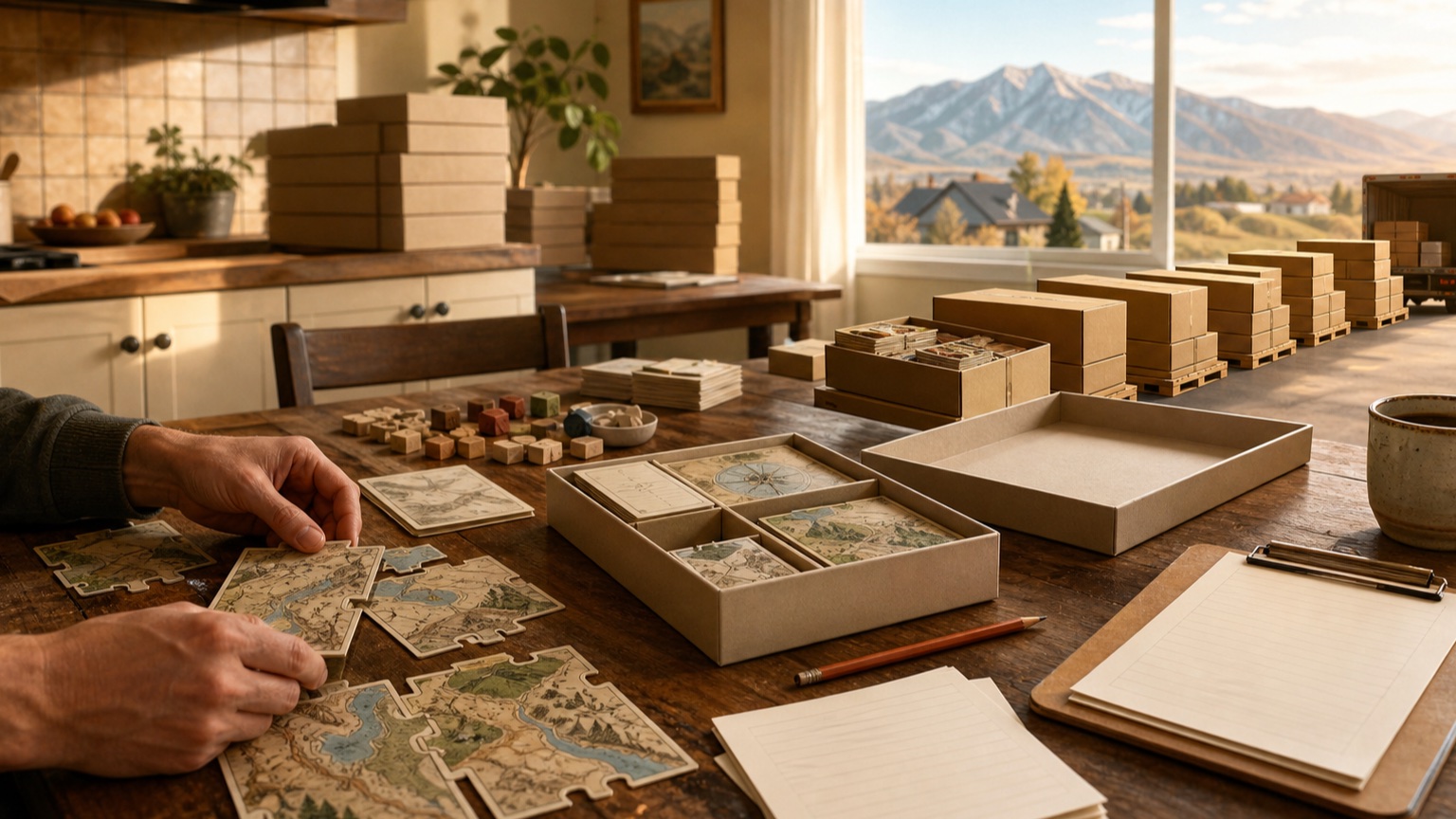
A game assembled around a Highland kitchen table is heading for a much less forgiving surface: the national retail shelf.
Finders Seekers announced Tuesday that its new title, *National Parks: The Cryptic Canyon*, had begun rolling out to Target stores and Target’s website. The company said it expected distribution across the retailer’s locations within roughly a week.
That timetable and the scope of the rollout come from a company-issued release distributed through PRWeb. Utah Main Street did not independently confirm inventory at every Target location, and Target’s public search page did not yield a reliably inspectable product listing during our review. The rollout should therefore be read as an announced expansion still in progress, not as proof that every store has the game in stock today.
What is independently visible is the product system beneath the announcement. Amazon lists an existing Finders Seekers National Parks escape-room game, labels the seller as a small business and shows other destination-themed titles from the same maker. The company’s own website presents a recurring-game model with month-to-month and prepaid plans, a set shipping schedule, themed recipes, music and puzzle materials.
That makes the Target announcement more interesting than a single new purchase order.
Finders Seekers is not simply moving a box from one checkout page to another. It is taking a product developed inside a direct relationship with customers and placing it inside a system where shelf space, replenishment, packaging clarity and price comparison all become more consequential.
The company says operator Cody Dingus began the business in 2017, initially assembling games with his family at home. Its release also claims more than one million games sold worldwide. That sales figure is company-reported and was not independently audited for this article; the company’s live homepage still displays an older claim of more than 900,000 games sold, which may reflect a website update lag rather than a contradiction.
The operational lesson does not depend on either number.
A direct-to-consumer business can explain a complicated product with a landing page, a video and a series of emails. A retail package gets a few seconds. The shopper has to understand what the product is, who it is for and why it is worth carrying to the register without a guided tour from the operator.
That compression is hard.
It also exposes every weak point behind the box. A missing component that can be replaced through an email exchange becomes more expensive when the unit traveled through a distributor and a national retailer. A packaging change that once affected a small production run can become a warehouse problem. A demand spike that looks flattering online can create empty shelves, delayed replenishment or rushed quality control at scale.
Finders Seekers appears to have one useful advantage: the core experience has already been repeated across destinations and sales channels. Its catalog suggests a format that can carry new stories without requiring the company to reinvent the entire product each time. That is the kind of repeatability a larger retail partner can understand.
The National Parks theme may also reduce the explanation burden. Customers do not need prior knowledge of a fictional world to recognize the setting. The subject provides familiar visual and cultural material while leaving room for the puzzles and narrative to do something distinctive.
For Utah operators, the practical question is not whether Target might call. It is whether the business could survive the call without losing what made the product good.
A useful exercise today is a **retail-readiness audit**. Choose the product you would most want placed in 100 unfamiliar stores and answer five questions:
1. Can a first-time shopper understand it in ten seconds? 2. Is the margin still sound after wholesale pricing, freight, returns and distributor fees? 3. Can every component be reordered from a documented specification? 4. Who owns the response when a large order lands beside ordinary customer demand? 5. What quality check cannot be skipped, even under a deadline?
Any answer that lives only in the operator’s head is the next procedure to document.
The kitchen table is often where a product earns its character. National retail tests whether the business around it has earned the same degree of care.