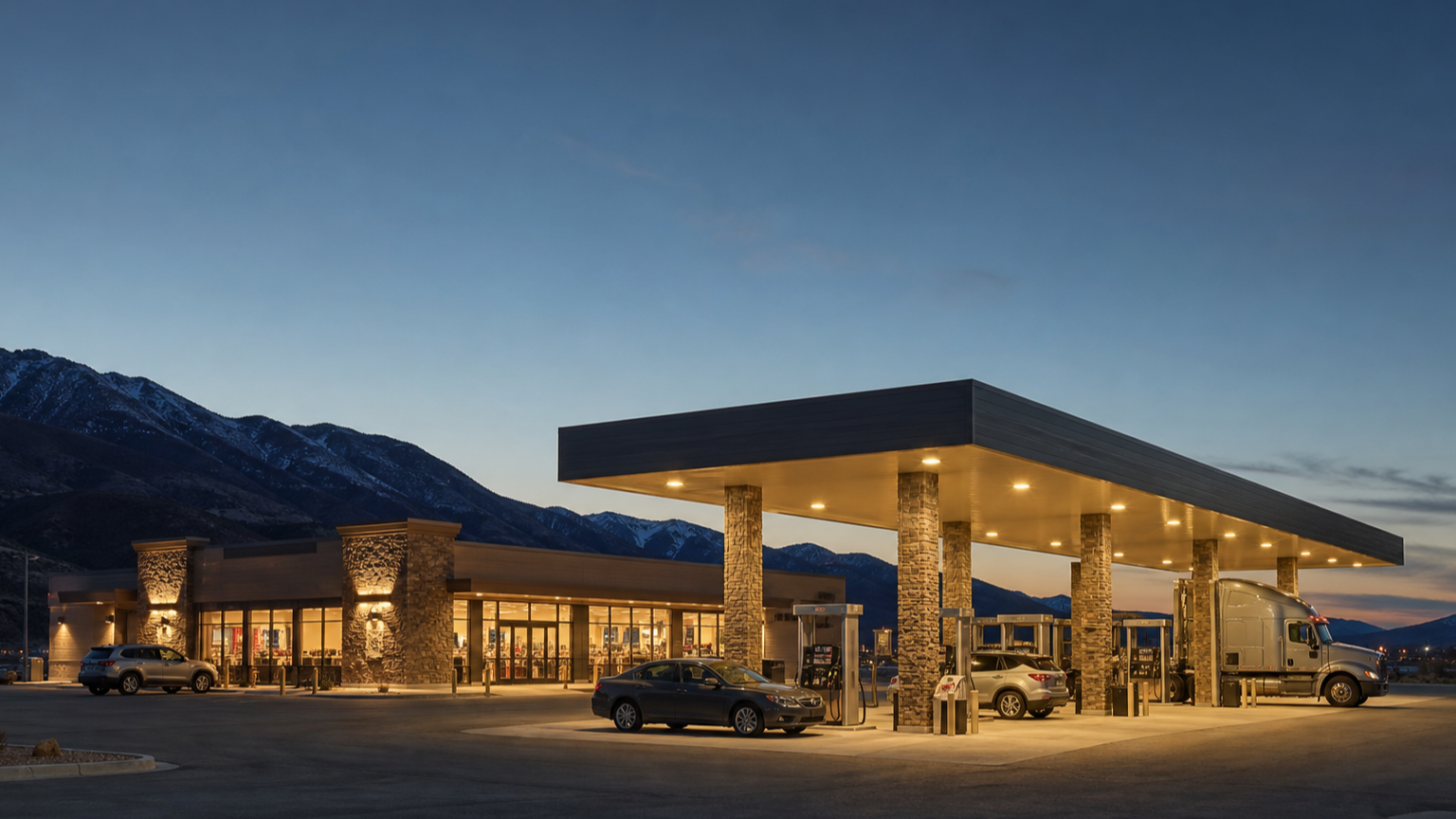
At 8 a.m. Thursday, a new 24-hour competitor opened just west of Interstate 15 in Weber County.
QuikTrip’s first Utah travel center is now operating at 1675 W. 12th Street in Marriott-Slaterville. It has 16 gasoline pumps, six high-flow diesel bays for tractor-trailers, a full-service kitchen and enough parking to serve local drivers, commuters and commercial traffic.
ABC4 reported that the store created 24 local jobs. CSP Daily News reported that QuikTrip intends to open its next Utah location in Springville in December, followed by additional stores across the state.
Those are the reported facts. The larger local-business signal is what the opening does to customer expectations.
## The new competitor is a service standard
A large travel center does not compete only on fuel prices. It competes on certainty.
The doors are open at an inconvenient hour. The kitchen is working. A tractor-trailer can enter without improvising. A commuter knows there will be parking, food and a functioning checkout in one stop.
That reliability matters because customers rarely describe convenience in strategic language. They simply change their route.
For an independent market, restaurant, repair shop or service station nearby, the wrong response would be to imitate QuikTrip’s footprint. A local operator is unlikely to win a pump-count contest against a company that CSP describes as having more than 1,200 stores in 22 states.
The useful response is to identify which promise the new arrival makes—and then decide where a smaller business can make a sharper one.
## Size creates reach, but focus can create preference
QuikTrip’s opening package is broad: fuel, diesel access, made-to-order food, grab-and-go products, app-based discounts and round-the-clock hours. Breadth is the advantage.
A local operator can counter with specificity.
A nearby café might become the corridor’s fastest genuinely local breakfast. A tire shop might publish a clear after-hours recovery process. A market could carry the regional products a national assortment will overlook. A restaurant could make online ordering dependable enough that a driver can place an order before leaving the freeway.
The question is not, “How do we become another travel center?”
It is, “What can a customer reliably get from us that this travel center is not designed to provide?”
That distinction protects operators from expensive, reactive decisions. Extending hours without measured demand can turn a competitive response into a labor problem. Discounting across the board can produce traffic without margin. Adding a large menu can slow the one product customers already value.
The uncertainty here should be stated plainly: public reports confirm the facility, its initial employment count and QuikTrip’s announced expansion plan. They do not yet show how much traffic the location will capture, which nearby businesses will gain or lose visits, or whether the Springville schedule will hold.
Those outcomes must be measured rather than assumed.
## Run a corridor audit today
Local operators within a practical driving radius can respond before a full quarter of sales data arrives.
Start with a 30-minute audit:
1. Search your business from a phone as if you were an unfamiliar traveler. Confirm that today’s hours, phone number, directions and ordering link are correct. 2. Write down the one purchase occasion you intend to own: early breakfast, local gifts, emergency repair, family dinner, specialty groceries or another narrow need. 3. Record customer counts and average transaction value for the same two-hour blocks each week through August. 4. Ask five customers what made them choose your stop rather than the nearest alternative. Capture their exact reason without turning it into a sales pitch. 5. Set one decision rule before changing operations—for example, extend an hour only if measured demand can cover labor and overhead for four consecutive weeks.
The first Utah QuikTrip is a significant entrant, but it is also a useful piece of market research delivered in concrete.
It shows where a sophisticated retailer sees durable traffic, what it believes travelers expect and how strongly it values operational consistency. Main Street businesses do not need to match the building. They need to make their own promise easier to understand—and harder to replace.